
By Nitin Jaiswal | The Black Elephant
India has stopped saying it cannot afford its own ambition. The diagnosis has matured. The country drafts frontier policy, it has engineers who reach Mars on a tenth of a Western budget, and it has money a research fund, a corporate social-responsibility mandate, tax deductions, corporate balance sheets heavy with cash. What it lacks, the consensus now says, is leadership: a figure who can rally the room and carry the mission. Fund the gap, find the leader, and the rest follows.
Two metro systems, built in the same country a generation apart, settle what is actually missing.
Kolkata’s metro was run through the ordinary railway bureaucracy. It was badly delayed and it ran twelve times over budget.
The cause, on the record, was political meddling and bureaucratic delay. Delhi’s metro was built to escape precisely that fate made an autonomous corporation with its own power to hire, tender, and control funds, with an empowered chief to run it. It opened on time, and propagated to twenty more cities.
Same engineering. Same state. The same decade of Indian capability. The variable was not money and not talent. It was whether anyone was granted the autonomy and handed the mandate to own the whole thing.
To own the whole thing means something specific: one named office that hires, lets the contracts, holds the budget, and carries the blame when it fails. Delhi had it. Kolkata had four agencies and no one.
—
This is the part the room walks past. When India faces a challenge measured in decades, it reaches for an instrument it can control a ₹14,000 crore research fund, a two percent CSR mandate, an R&D tax deduction. They move real money and bank visible reform credit, but none creates an owner; the one lever pointed straight at research, the weighted R&D deduction, was not expanded but cut, from 200 percent to 100 percent by 2020. The system reaches for the instruments it can keep its hands on, and declines to build the owner it would have to let go of.
—
The reason is not incompetence, and not a shortage of capable people. It is that the two halves of an owner are exactly the two things the apparatus is built to retain.
An autonomous institution with multi-cycle funding surrenders control over the budget. An empowered mission-owner placed inside it surrenders control over the appointment. Disbursing a fund or mandating a spend surrenders neither and still photographs as action. So the controllable lever is chosen every time, and the institution-and-owner that would actually carry the horizon is the option no one in the room is rewarded for building. The architecture assumes a long problem can be funded into existence without anyone being made to own it.
The owner a long mission needs is an autonomous institution with an empowered chief inside it and that is the one thing a control-keeping system will fund anything to avoid building.
—
Strip away the four sophisticated explanations and one plain thing is left. India keeps funding the mission and refusing to build the owner not because it has never built one, but because every time it did, it had to grant an autonomy and place a mandate it does not willingly part with. The rare successes happened inside rare windows: strategic urgency, a protective sponsor, a prior failure loud enough to force the system’s hand. Kolkata was that failure. Delhi was what the fear of repeating it produced. The root is not absent money and not absent talent — it is a paired owner the system declines to build because building it costs control.
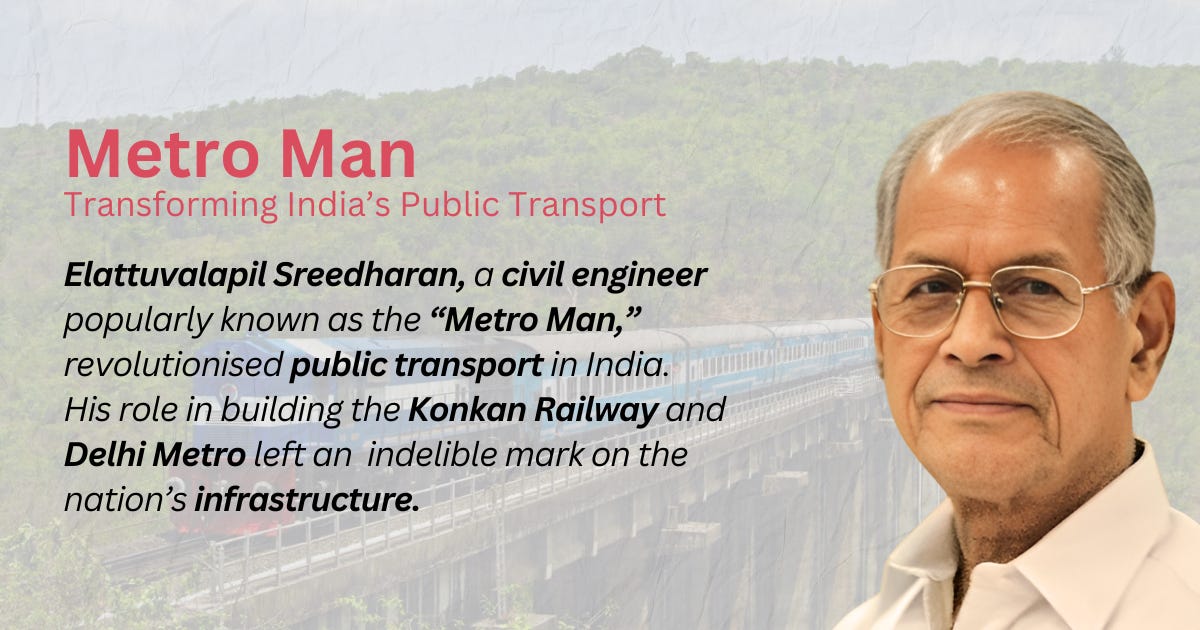
Notice what this is and is not. It is specific: a named fund, a named statute, three named institutions, one natural experiment between two tunnels. The cost is specific. And the silence is structural, not polite because the honest answer locates the refusal inside the same apparatus that funds the gap and praises the old models. The room can celebrate ISRO and Sreedharan precisely because celebration is cheaper than granting again what they required.
—
Be precise about the limits, because the pairing is not a master key. ISRO and Delhi Metro were delivery and mission execution, where India already had the skill. Generalising “the pairing built them” into “the pairing will close the research gap” overreaches discovery carries a talent constraint that metro-building does not. India has 262 researchers per million people; South Korea has more than eight thousand, and no autonomy grant manufactures researchers who are not there. A named owner cannot will a land title clear or a court stay lifted either. The pairing does not dissolve those constraints. It decides whether anyone is answerable for the whole once they are worked. That is the test, not the escape.
—
The cost wears a face. Picture the engineer who could have been Konkan Railway’s next chief the figure the consensus says the country is missing. India does not hand her an autonomous corporation and a mandate to run it. It hands her a grant portal and a tax-deduction form. The talent is present and idle; the mission stays unowned.
The proof that the leader was never the scarce input: ISRO outlived Sarabhai by fifty years, and the Delhi Metro outlived its founding chief’s tenure without losing a step. The institution carried the people. India keeps searching for the people while declining to build the institution that would have carried them.
—
So before the next fund is announced, the next corpus tabled, the next mission launched, there is a prior question prior because answering it would bind a named office to an outcome it currently gets to fund, defer, and survive.
In the room where the next twenty-year challenge is being sanctioned the budget meeting, the cabinet note that fixes a target, lists four agencies, and names no one to own it is anyone being paired with an institution and empowered to carry the whole of it? Or is someone being handed money to spend, and a leader being wished for who, even if he arrives, will be ground down by the same bureaucracy that broke Kolkata?
—
I write about the consequential truths that are visible, evidenced, and systematically unaddressed in the rooms where decisions get made. If you’ve sat in one of those rooms, I’d like to hear what you saw. Join the conversation at Tuskers.
—
I am publishing a book - The Black Elephant: A 7,500-step truth in a 10,000-step world Nitin Jaiswal, @AgeTech Leadership Labs, Singapore, 2026.