
By Nitin Jaiswal | AgeTech Leadership Labs
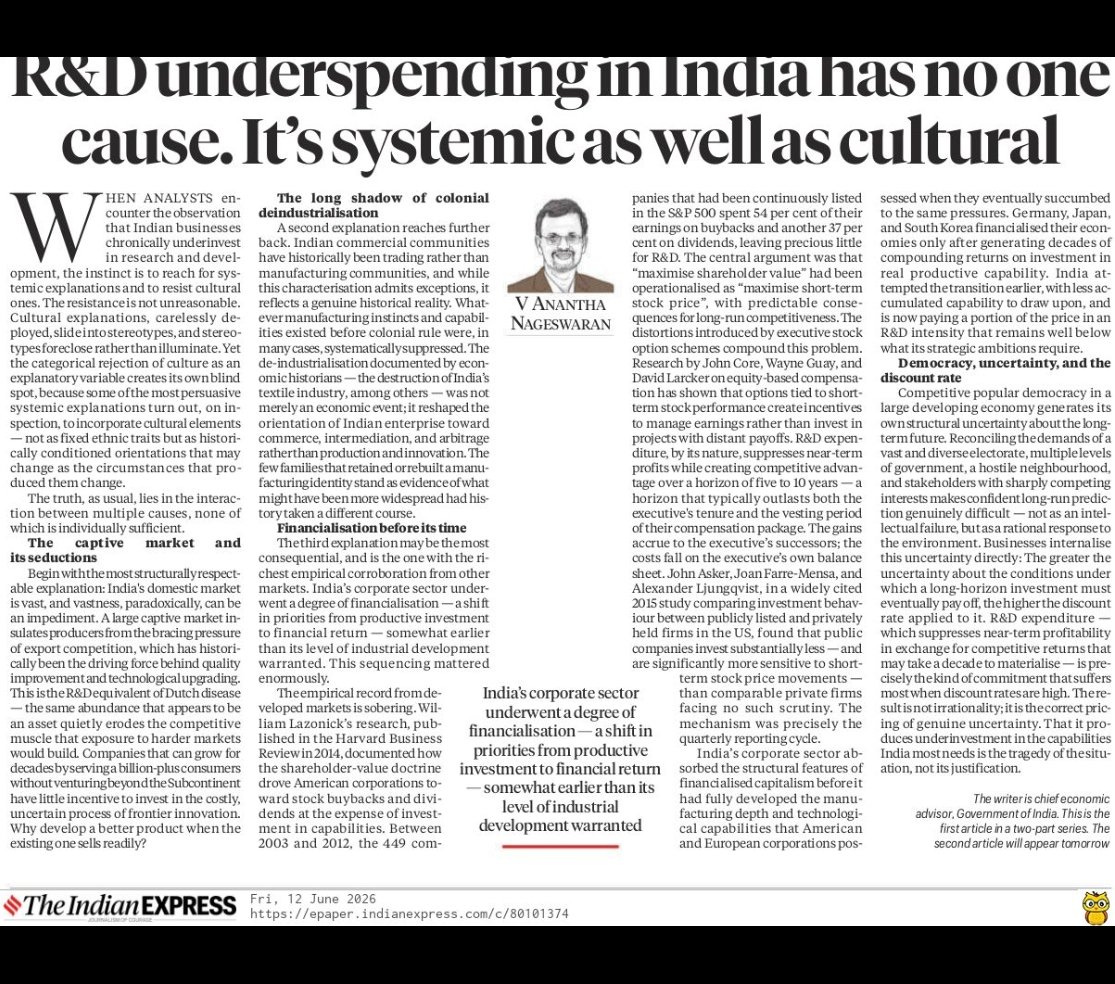
India does not spend enough on research, and for the first time the explanation is arriving from the top of the building. The country’s Chief Economic Advisor has set out, carefully and with citations, why the private sector will not close the gap. The market at home is too easy to make competition urgent. The colonial inheritance bent the economy toward trade, not invention. Corporate India financialised before it industrialised. And a competitive democracy applies a high discount rate to any payoff a decade out.
Four causes, all real, all sourced. The room nods. We have stopped saying India cannot afford its science; we now say, correctly, that the deficit is structural and cultural, not fiscal. The diagnosis has matured.
—
The same government then did the rarer thing. It built an owner. The national research foundation was chartered to carry exactly the long horizon the private sector won’t a statutory body under the Prime Minister, targeting ₹50,000 crore over five years. And then it committed ₹14,000 crore. Barely a third.
The other ₹36,000 crore is not a committed government line at all.
It is left to what the Act calls donations from any other source public-sector enterprises, the private sector, philanthropy, international bodies, plus recoveries and investment income. Nearly three-quarters of the national research corpus is uncommitted, a soft line the private sector is expected to lead. So one arm of the state demonstrates that no firm answering to shareholders will bankroll a ten-year payoff, and the other builds the nation’s research future on a balance it has chosen not to fund itself and expects that same private sector to carry. Both documents are serious. Neither disputes the numbers in the other. Nobody has put them in the same room.
—
There is an innocent reading, and it deserves a sentence. Perhaps the soft line was only ever catalytic seed the exchequer always meant to backfill once the first results landed. If a committed government backstop exists, there is no contradiction, only a financing sequence. But none is written into the Act or the funding notifications. And the separate ₹1 lakh crore “patient capital” fund sitting alongside it is structured as recoverable loans from the public purse capital the taxpayer expects back not the unrecoverable bet that owning a long horizon actually requires. Patience the state can call back is not the same as ownership.
The state proved the long horizon would not fund itself then chartered the body meant to own it and committed barely a third of what it needs.
—
Look at why the horizon goes unfunded, and the four sophisticated causes collapse into one plain one. A firm answers to quarters. An executive answers to a vesting schedule. A minister answers to an election. The treasury answers to a budget year. Research answers to none of them it pays out in a decade, to whoever happens to be in the chair when it does.
No actor in the system holds a clock long enough to own the asset. The architecture assumes someone will carry a cost whose return arrives after every one of them has moved on. So the cost sits on no ledger, and the gap that everyone can measure is owned by no one.
The cleverest of the four causes does the quiet work here. Underinvestment, the argument finally concludes, is “the correct pricing of genuine uncertainty.” That single move reclassifies a gap someone could close into a tragedy everyone can only mourn. A choice becomes a weather pattern. And weather is nobody’s fault.
—
So the failure is not that India cannot see the problem. It has named it, sourced it, and built the body meant to carry it. The failure is narrower and harder to reach. The system was never built to hold a horizon this long, so for once it created the owner and then left it to raise three-quarters of its own corpus from the very sector the government’s own economist says will never fund it. It is worth asking, too, whether the firms most comfortable inside a protected domestic market have much appetite for bankrolling the frontier competition that funded research would eventually produce a question the diagnosis raises in passing and then leaves alone.
This is not a general complaint about budgets. The figures are specific: ₹14,000 crore committed against a ₹50,000 crore target, in a named fund, under a named Act, chaired by a named office. The cost is specific. And the silence is structural, not polite because the honest answer locates the contradiction inside the same government that wrote both halves of it.
—
None of this makes funding architecture the only constraint. India is also short of researchers, short of the university-industry links that turn money into capability, short of the absorptive capacity that would let a fully subscribed fund actually spend well. All true. But notice that those constraints are debated everywhere in every think-tank paper, every policy column, every panel on why the money problem is not really a money problem. The thing that is argued about constantly is not the thing being ignored. The funding contradiction is. It is the piece no one puts in the same room, precisely because the others are so comfortable to discuss.
—
The cost is not abstract. Picture one of the roughly eighty-five thousand Indian researchers now working abroad. Trained at public expense. Gone because no institution at home could offer a horizon long enough to stake a career on. India has 262 researchers per million people. South Korea has more than eight thousand. Every departure lowers the density that would have made the next cohort’s funding productive and over two decades the shortfall stops being a line on a chart and hardens into a ceiling. When India falls short of its 2047 ambitions, the ceiling will be read back as proof that “the private sector wouldn’t step up,” which is exactly how the diagnosis pre-emptively frames it.
—
There is a country that did this in the right order. South Korea which the op-ed itself cites financialised only after decades of compounding real returns on research. The mechanism worth importing is not that Korea admired science. It is that the Korean state acted as the patient owner of first resort during the capability-building phase, carrying the long horizon on its own balance sheet until private returns matured. Only then did private R&D climb past seventy percent of the total.
Korea built the owner first and let the private share grow into it. India has assumed the private share at the outset, before the capability exists to make private patience rational. It inverted the sequence and called the inversion a strategy.
—
So before the next foundation is chartered, the next corpus tabled, the next mission launched, there is a prior question prior because answering it would bind a named office to an outcome it currently gets to share, defer, and survive.
In the room where that ₹36,000 crore was left uncommitted the budget meeting, the cabinet note that fixes a target and names no one to fund it when the soft line comes up short, as the government’s own economist has explained it will, whose horizon was it ever supposed to be?
—
I write about the consequential truths that are visible, evidenced, and systematically unaddressed in the rooms where decisions get made. If you’ve sat in one of those rooms, I’d like to hear what you saw. Join the conversation at Tuskers.
—
My Upcoming Book: The Black Elephant: A 7,500-step truth in a 10,000-step world Nitin Jaiswal, AgeTech Leadership Labs, Singapore, 2026.